Single-Shaft vs Double-Shaft for Plastic Recycling: A Professional Guide
In the plastic recycling industry, selecting the “wrong” size reduction technology isn’t just an inefficiency—it’s an operational liability. When engineers evaluate Single-Shaft vs Double-Shaft for Plastic Recycling, the decision rarely comes down to brand preference. Instead, it is a calculation of physics: do you need the precision shearing of a single-shaft machine, or the brute-force fracturing of a double-shaft system?
At Repolyx, we see this mismatch constantly. A facility installs a double-shaft shredder for heavy purging lumps, only to find the “strips” it produces jam their conveyor. Conversely, a recycler tries to feed bales of agricultural film into a standard single-shaft unit and watches throughput tank as the material wraps around the rotor.
This guide breaks down the mechanical DNA of both machines, helping you match the shredder to your specific feedstock and downstream requirements.
The Core Difference: Shear vs. Tear
The fundamental difference lies in how the blade engages the material.
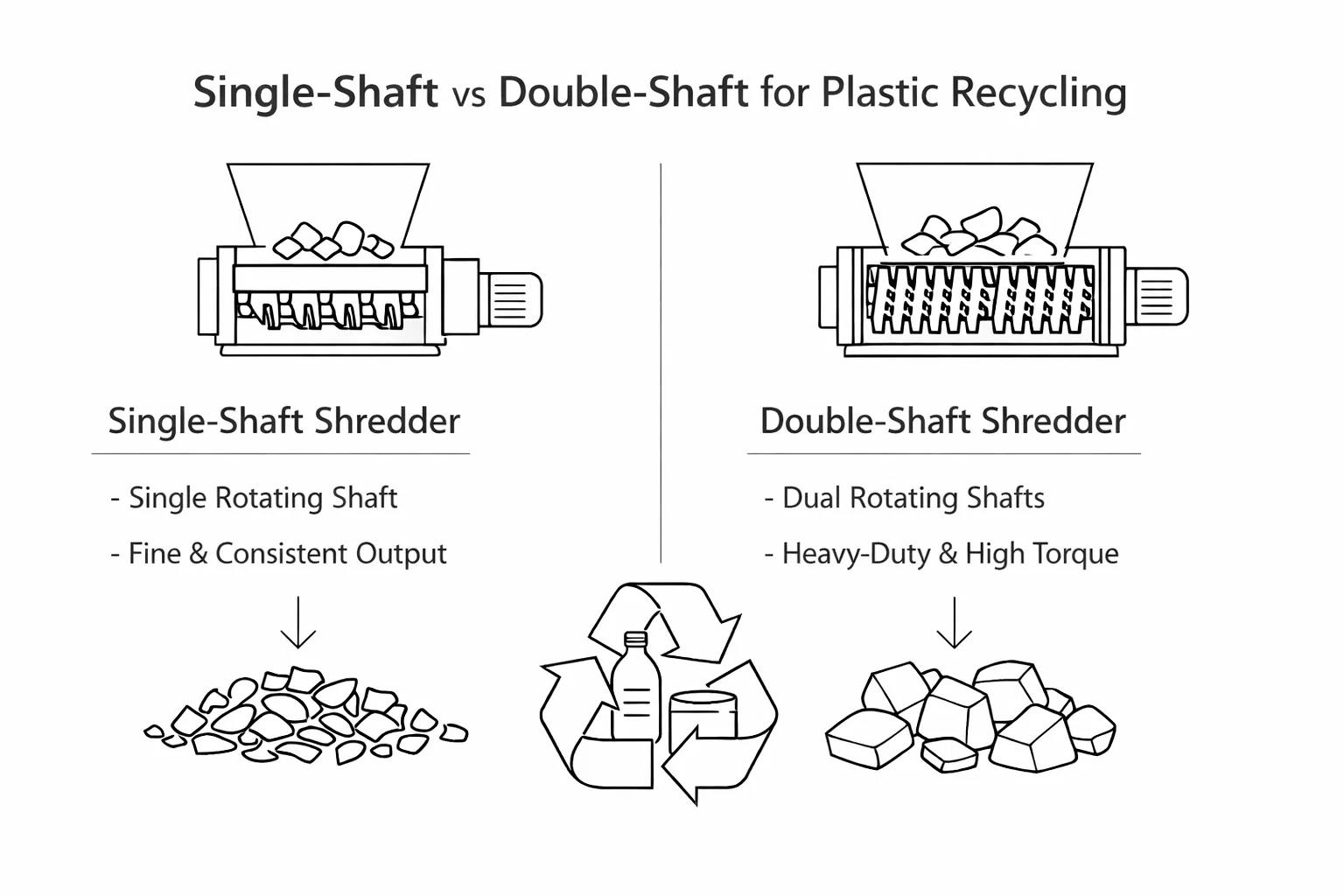
- Single-Shaft Shredders operate on a high-speed, controlled cutting principle. A hydraulic ram pushes material against a single rotating shaft. The knives “shear” the plastic against a stationary bed knife, much like scissors. The material remains in the chamber until it is small enough to pass through a sizing screen.
- Double-Shaft Shredders rely on low-speed, high-torque tearing. Two counter-rotating shafts with intermeshing hooks grip the material, fracturing and pulling it through the gap. There is typically no sizing screen; the output size is determined by the width of the blades.
Single-Shaft Shredders: Precision and Uniformity
For most “clean” recycling applications where the material goes directly to a granulator or extruder, the Single-Shaft Plastic Shredder is the industry standard.
Mechanism
A hydraulic pusher arm is critical here. It detects the load on the rotor (via amperage draw) and automatically manages the feed rate, pushing material into the cutters or retracting to prevent jams. The rotor spins at a moderate speed (60–100 RPM), delivering consistent torque.
Best Applications
- Hard Plastics: HDPE pipes, massive purge lumps (patties), and thick-walled PP containers.
- Injection Molding Waste: Sprues, runners, and rejected parts.
- Defined Output: Because of the internal screen (typically 20mm–80mm), you get a uniform chip.
The Engineer’s Perspective
Pros: The output is a clean, uniform “chip” or “flake.” This is excellent for feeding directly into a Crusher for fine grinding or a wash line. You can control the particle size simply by changing the screen. Maintenance is straightforward; bolt-on knives can be rotated and replaced easily.
Cons: While versatile, standard single-shaft units can struggle with very light, voluminous material like loose film unless equipped with a specialized rotor and pusher program.
Tip: If your downstream process is a friction washer or a screw conveyor, a single-shaft shredder is almost always the safer choice because it eliminates long strips that cause wrapping and jamming.
Double-Shaft Shredders: Torque and Bulk Handling
Double-shaft machines (often called dual-shear shredders) are the “linebackers” of recycling. They don’t cut cleanly; they destroy.
Mechanism
The two shafts rotate slowly (often 10–30 RPM) but with massive torque. The hooked blades grab bulky objects and pull them into the center cutting zone.
Best Applications
- Contaminated Feedstock: Bales of mixed plastics containing dirt or metal (tires, e-waste, white goods).
- Bulk Volume Reduction: Breaking bale wires and de-compacting material before sorting.
- Hollow Objects: Blue barrels, IBC totes, and car bumpers that bounce off a single-shaft rotor.
The Engineer’s Perspective
Pros: They are self-feeding and almost impossible to stall. The slow speed means low noise and low dust. They handle “unshreddable” contaminants better than single-shaft units, often just chewing through them or stopping without catastrophic damage.
Cons: The output is irregular. You will get long strips or chunks (“shreds”) rather than chips. This output is usually too coarse for a wash line and must go through a secondary shredder or a heavy-duty granulator. Replacing the shafts or blades is a major maintenance event, often requiring the disassembly of the entire cutting chamber.
Comparative Analysis: Making the Choice
| Feature | Single-Shaft Shredder | Double-Shaft Shredder |
|---|---|---|
| Output Consistency | High (Screen Controlled) | Low (Strips/Chunks) |
| Throughput (Bulk) | Moderate | High |
| Maintenance | Easy (Bolt-on Knives) | Complex (Shaft Removal) |
| Blade Wear | Moderate (Shearing) | Low (Low Speed) |
| Energy Efficiency | Good (Controlled Load) | Variable (High Torque) |
| Downstream Readiness | Ready for Granulator/Wash | Requires Secondary Step |
Decision Matrix: Which One Do You Need?
To simplify the Single-Shaft vs Double-Shaft decision, look at your input and your next step.
-
“I need to feed an extruder or a wash line immediately.”
- Verdict: Single-Shaft. You need the screen-controlled output size (e.g., <40mm). A double-shaft’s long strips will jam your augers.
-
“I am processing 1-ton bales of dirty agricultural film.”
- Verdict: Double-Shaft (Primary). Use it to break the bales and separate heavy contaminants. You will likely need a single-shaft machine as a second stage to size the material for washing.
-
“I recycle rigid HDPE pipes and factory lumps.”
- Verdict: Single-Shaft. This is the classic use case. The hydraulic pusher creates the necessary pressure to shave down solid blocks of plastic that a double-shaft machine would just scratch.
-
“I have mixed waste with potential metal contamination.”
- Verdict: Double-Shaft. The low speed and robust teeth withstand shock loads better. A single-shaft rotor spinning at 100 RPM will suffer catastrophic blade damage if it hits a steel bolt.
Conclusion
Neither technology is universally “better.” The Single-Shaft shredder is a precision instrument for creating specification-grade feedstock. The Double-Shaft shredder is a volume-reduction workhorse for difficult or contaminated streams.
For most internal recycling and post-industrial applications (like Rigid Plastic Washing Lines), the Single-Shaft Shredder offers the best balance of output quality, ease of maintenance, and operational cost.
If you are unsure which mechanism fits your material stream, contact our engineering team. We often run material tests to validate throughput and wear life before you commit to a machine.