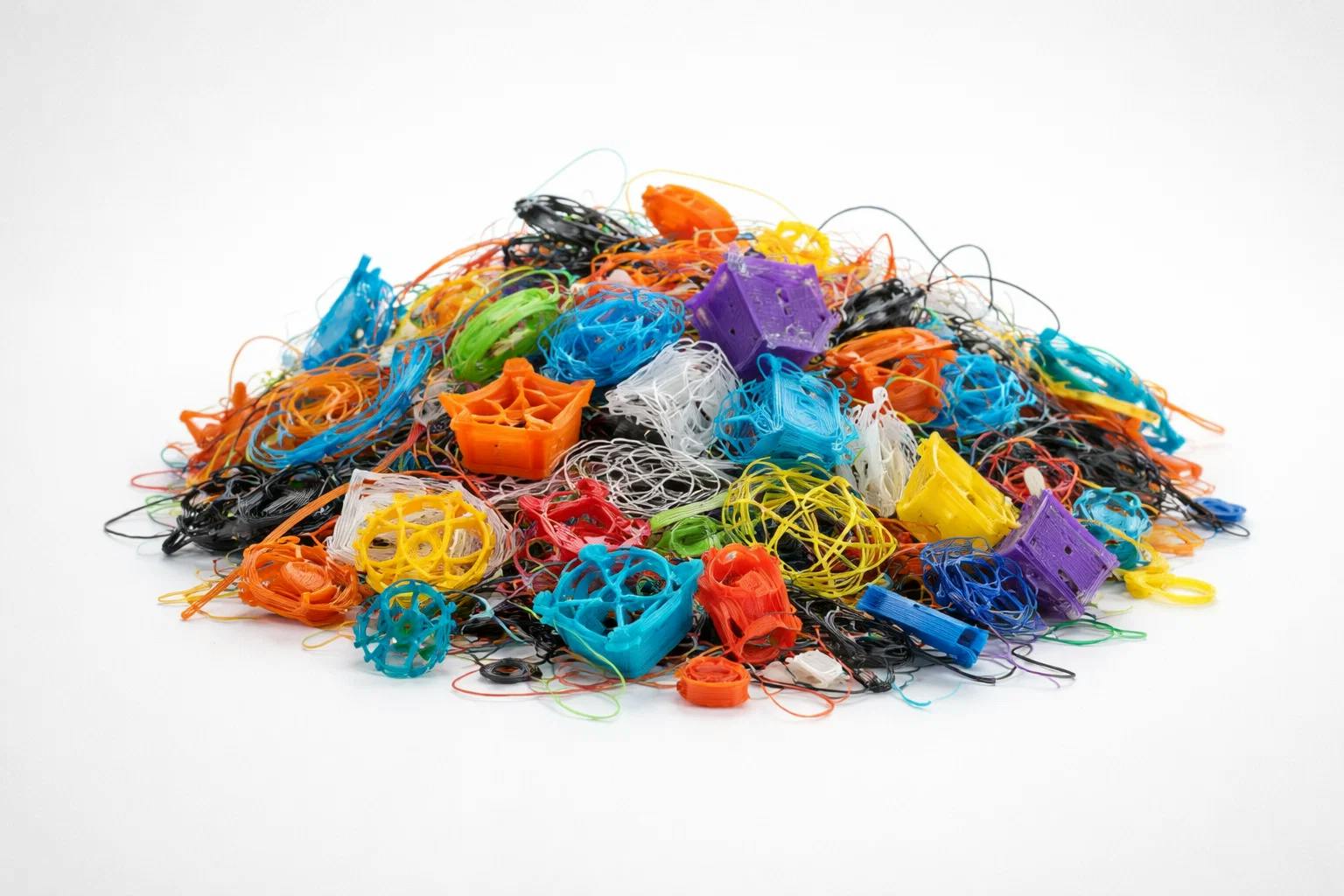
What is a 3D print shredder and how does it work to transform failed prints into viable feedstock? A 3D print shredder is a low-speed, high-torque size reduction machine engineered to process thermoplastics like PLA, PETG, and ABS into uniform 3-5mm granules. Unlike general waste crushers, these units prioritize shear force over impact to prevent thermal degradation of heat-sensitive polymers. For a real-world reference spec, see our Desktop 3D Print Shredder. This guide examines the engineering constraints, operational mechanics, and selection criteria for integrating shredders into a closed-loop additive manufacturing workflow.
The Engineering Behind 3D Print Shredders
The core function of a 3D print shredder is to mechanically fracture polymer chains without generating excessive friction heat. Standard thermoplastics used in Fused Deposition Modeling (FDM) have low glass transition temperatures ($T_g$)—for example, PLA softens at roughly 60°C. High-speed impact crushers (operating >500 RPM) generate friction that melts these plastics, causing machine jams and material degradation.
3D print shredders employ a single or dual-shaft design driven by a geared motor to operate at low speeds (typically 40–80 RPM). This configuration delivers high torque to shear through solid infill structures and support rafts while maintaining a processing temperature well below the material’s $T_g$.
Key Mechanical Components
| Component | Specification Standard | Function |
|---|---|---|
| Cutting Blades | D2 Tool Steel / SKD11 (HRC 58-62) | Provides wear resistance against abrasive fillers (carbon fiber, glass) and maintains sharp shearing edges. |
| Drive System | Planetary/Worm Gearbox | Reduces motor speed to multiply torque. Desktop units: 20-40 Nm; Industrial: >100 Nm. |
| Sizing Screen | Stainless Steel, 4-6mm Hex/Round | Determines final granule size. Critical for ensuring consistent feed into single-screw filament extruders. |
How Does a 3D Print Shredder Work?
The size reduction process follows a three-stage sequence designed to manage material stress and maximize output uniformity.
1. Feeding and Pre-shredding
Operators load waste material into the hopper. Gravity feeds the plastic into the cutting chamber. For safe operation, an anti-kickback design prevents material from being ejected. The shredder’s control system monitors motor current (amperage). If the resistance exceeds a set threshold (e.g., a solid 100% infill block), the “Auto-Reverse” function triggers to reposition the material and prevent shaft breakage.
2. Shearing and Granulation
The rotating knifes interlock with stationary fixed blades (counter-knives). As the shaft rotates, the blades apply shear force, slicing pieces off the main plastic body.
- Desktop Units: Typically use a “nibbling” action suited for hollow prints and failed supports.
- Industrial Units: Employ aggressive hook-shaped blades to grab and tear dense purge blocks.
3. Sizing Optimization
Cut particles fall onto a sizing screen located beneath the cutting chamber. Particles smaller than the screen aperture (e.g., 5mm) pass through into the collection bin. Oversized particles are swept back up by the rotor for recutting. This cycle ensures that the final regrind has a uniform bulk density, which is essential for stable screw extrusion in filament makers.
Selection Criteria: Desktop vs. Industrial
Choosing the right equipment depends on throughput requirements and material properties.
Desktop Shredders (Lab/Studio Grade)
- Throughput: 1-5 kg/hour.
- Torque: 25-40 Nm.
- Power: 150-300W DC Motors.
- Application: Educational institutions, design studios, and hobbyist print farms.
- Limitations: Cannot process solid purge blocks or engineering-grade materials like PEEK without stalling. Note that manual shredders, while cheaper, often lack the torque stability for consistent regrind quality.
Industrial Shredders (Production Grade)
- Throughput: >20 kg/hour.
- Torque: >200 Nm.
- Power: 1.5kW - 5kW AC Motors (3-Phase).
- Application: Large-scale bureaus, filament manufacturers, and recycling centers.
- Capabilities: Capable of processing solid parts, heavy spools, and abrasive composites continuously.
Maintenance and Operational Constraints
To maintain uptime and granule quality, adherence to a strict maintenance schedule is mandatory.
- Blade Sharpening: Check blade edges every 500 operating hours. Dull blades increase motor load and generate dust (fines) rather than clean-cut granules.
- Clearance Adjustment: The gap between rotating and stationary blades should be kept between 0.1mm and 0.3mm. Excessive clearance causes material to fold rather than cut.
- Gearbox Lubrication: Sealed units are maintenance-free; however, industrial gearboxes require oil changes annually or every 2,000 hours.
- Contamination Control: PLA and PETG are incompatible. Thoroughly vacuum the cutting chamber when switching materials to prevent cross-contamination that weakens the final recycled filament.
Conclusion
Understanding what a 3D print shredder is and how it works allows engineers and procurement managers to implement effective waste recovery systems. By selecting a machine with adequate torque, appropriate blade metallurgy, and precise screening, organizations can convert scrap costs into raw material savings. Whether opting for a desktop unit or an industrial line, the focus must remain on low-speed, high-torque processing to preserve polymer integrity for closed-loop recycling.